

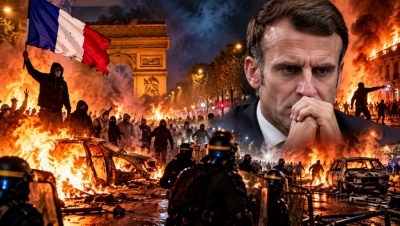
France finds itself in a state of intense social and political turmoil following weekend mass demonstrations that expanded across dozens of cities and in many cases resulted in violent clashes, looting, and arson. The country awoke to widespread damage along roads, shops, and public buildings, while tensions persisted throughout the day. In Paris, Marseille, Lyon, Bordeaux, and Limoges, serious incidents were recorded, with police executing mass arrests and deploying tear gas to disperse gatherings. According to data announced by French authorities on Sunday, detentions and arrests reached 2,397 nationwide, while nearly 1,000 police officers, gendarmes, and firefighters sustained injuries, according to figures cited by the newspaper Le Monde. One demonstrator died in Paris following a cardiac arrest during the mobilizations, according to authorities. Images from affected areas capture the scale of destruction as the government attempts to restore order and curb further escalation.
Happy Sunday from Paris with LOVE Bon dimanche ? #Paris #Pillages #17octobre #chatelet #emeutes https://t.co/NjeGL8lKTI
— LeeLoo (@Loo_Atreides) October 18, 2026
Concurrently, political confrontation intensifies regarding the root causes of the social explosion, the efficacy of security measures, and the government's response to protesters' demands.
From student mobilizations to generalized social discontent
The demonstrations did not emerge out of nowhere. Weeks of student and youth mobilizations had preceded them, featuring core demands centered on improving school conditions, addressing teacher shortages, and boosting funding for public education. Gradually, the mobilizations broadened and tied into mounting discontent over the cost of living, fuel prices, household purchasing power, and the state of public services. Student organizations, labor unions, and citizens expressing opposition to the government's economic and social policies participated in the movement. The participation of the CGT labor confederation and other organizations contributed to expanding the protests beyond the initial student core. According to the French Ministry of Interior, approximately 550,000 people participated in Saturday's demonstrations. Organizers offered a significantly higher estimate, pointing to roughly 800,000 protesters nationwide. The discrepancy in estimates captures the mobilization's scale without negating the fact that hundreds of thousands took to the streets. In many cities, gatherings unfolded peacefully. However, elsewhere, participating factions clashed with police forces and launched attacks against public and private facilities.
Paris: Clashes at Republic Square and shop looting
The French capital stood at the epicenter of the incidents, with Republic Square and surrounding streets transforming into a field of tension. On Saturday, police executed 855 arrests in the Paris region, a figure authorities characterized as exceptionally high. During the clashes, attacks against police officers, destruction of shops, arson of objects, and widespread damage to public spaces were documented.
Rioters raised the Palestinian flag at the Statue of the Republic, Paris, France (I believe this was yesterday) https://t.co/0JZ5b4ZU1y
— Open Source Intel (@Osint613) October 18, 2026
On Sunday, hundreds of demonstrators gathered once more at Republic Square despite an increased police presence. The situation remained tense, with security forces deploying tear gas and executing new interventions when disturbances flared. Streets surrounding the square were littered with shattered glass, destroyed storefronts, and debris. Cleanup crews worked to clear the damage, while residents and business owners attempted to tally their losses. The capital's imagery underscored the magnitude of the collision between mass social protest and groups engaging in violent acts. Many citizens expressed support for protesters' demands while simultaneously condemning looting and destruction.
Limoges: Severe damage to the historic town hall
Particularly severe was the situation in Limoges, where the historic town hall suffered extensive damage from a fire erupting amid the disturbances. Flames destroyed a large portion of the building, and its clock tower collapsed. The blaze delivered a heavy blow to a historic public structure that forms part of the city's architectural heritage. Mayor Guillaume Guérin maintained there was an organized intent to commit arson and expressed concern over the adequacy of police forces deployed to the area. Concurrently, he demanded securing necessary resources for damage restoration, warning that the city cannot shoulder the cost alone. Local authorities described the events as grave, given that elected officials, employees, security personnel, and citizens were inside the building when the fire broke out. The town hall's destruction emerged as one of the weekend's most defining incidents, sparking intense political debate regarding public infrastructure security and official preparedness.
Marseille, Lyon, and Bordeaux at the center of disturbances
The unrest was not confined to the capital. In Marseille, groups of demonstrators breached the entrance and entered the town hall reception area for a brief period. Simultaneously, damage was recorded at a police station as authorities sought to prevent the escalation of disturbances. In Lyon, a fire broke out at a tourist service facility, which sustained damage. Municipal authorities were summoned to confront the consequences of the destruction and coordinate restoration work. In Bordeaux, a group of individuals with concealed faces broke into the residence of the local prefect, alongside reported shop looting. Local authorities cited significant losses in the city's commercial activity. Destruction spread to other parts of France, ranging from Lille to Strasbourg, with cleanup crews and municipal services operating Sunday to restore public spaces. The financial cost of the damage has not yet been fully assessed. Nonetheless, initial estimates from businesses and local authorities indicated losses are substantial.
Injuries and investigations into police weapon use
Beyond material damage, injuries sustained during the mobilizations provoke particular concern. According to French authorities, hundreds of security and firefighting personnel were injured, with total figures announced Sunday approaching 1,000. Concurrently, the Mulhouse prosecutor's office announced an investigation launched after the severe injury of a 17-year-old girl who lost vision in one eye. Authorities are examining the incident's circumstances and the deployment of a crowd control police weapon. An investigation was also launched following the injury of a young demonstrator in Saint-Étienne who lost his hand. These specific cases are expected to undergo thorough scrutiny, as they thrust policing practices and the deployment of crowd suppression tools during demonstrations back into the spotlight. Authorities are called upon to clarify the circumstances of the injuries while political confrontation surrounding the management of mobilizations intensifies.
Macron: "Rage and shame" over images of destruction
Faced with the scale of the disturbances, French President Emmanuel Macron delivered a televised address Sunday, appealing for calm and condemning attacks and looting. The French president differentiated peaceful demonstrations from violent acts, acknowledging that citizens protesting peacefully hold legitimate demands that must be heard. Concurrently, he emphasized that the destruction of public buildings and businesses cannot be justified. Macron pledged that those responsible for looting will be held accountable and that damages must be repaired. Moreover, he instructed competent authorities to cooperate with mayors to protect public buildings and enterprises. He did not announce, however, the declaration of a state of emergency, despite related pressure from right-wing politicians. Instead, he left open the prospect of localized bans on gatherings should it prove necessary to safeguard public safety. The address attempted to draw clear lines between the right to protest and violence without offering immediate, detailed answers to all the social and economic demands that triggered the mobilizations.
Government under pressure over its handling
The scale of the disturbances raised questions regarding the adequacy of security measures and the preparedness of police forces. Prime Minister Sébastien Lecornu and other government officials attributed the violence to organized far-left groups and individuals participating in looting. This constitutes the government's assessment, which does not substitute for investigating liability in each individual incident. Simultaneously, Interior Minister Laurent Nuñez found himself at the center of criticism concerning crisis management and official operational readiness. According to Reuters, Laurent Nuñez submitted his resignation to the president Monday following the weekend's events. Emmanuel Macron, however, refused to accept it, judging that maintaining the administrative chain of command and the coordination of security forces is vital. The president instructed the minister to advance new approaches as rapidly as possible to counter looting and restore order. This development constitutes the most recent political event as October 19 dawns, demonstrating that the consequences of the disturbances transcend public safety to directly impact the governmental machinery.
The opposition's reaction
Events triggered fierce confrontation among political forces ahead of the 2027 presidential elections. Far-right leader Marine Le Pen called for calm, condemning the destruction and arguing the country must not grow accustomed to scenes of looting and chaos. Concurrently, she leveled harsh criticism against the government over how it handled the crisis.
A bird's-eye view of Paris. https://t.co/0HGux8jx8Y
— ???????? ????? (@SprinterPress) October 18, 2026
On his part, Jean-Luc Mélenchon, head of La France Insoumise, argued the government must answer the demands of students and youth. He participated in Saturday's march in Paris, clarifying that supporting the movement does not entail accepting looting or destruction. The confrontation concerns both liability for the disturbances and the social conditions fueling the mobilizations. The government emphasizes restoring order and punishing those responsible, whereas opposition politicians insist, through varying approaches, on the necessity of political answers to protesters' demands.
Businesses tallying their losses
Consequences affecting the business community are likewise significant. Carrefour CEO Alexandre Bompard told French television network BFMTV that roughly 50 company stores sustained damage, of which 20 were looted. Losses, according to the same statement, total tens of millions of euros. The French government announced it will examine ways to support business owners who suffered damages. Economy Minister Roland Lescure underscored that those responsible for the destruction must be held accountable and shoulder restoration costs. Concurrently, the mayors of Paris, Marseille, and Lyon requested a meeting with the prime minister to evaluate the extent of damages and coordinate responses to the consequences. The true economic footprint of the disturbances will become clearer in the coming days as inventories by businesses and public services conclude.
Monday finds France facing critical decisions
Today, Monday, October 19, the French government must confront two fronts simultaneously: restoring public order and managing social discontent politically. Sébastien Lecornu is expected to chair an interministerial crisis management meeting focused on evaluating damages to businesses and public infrastructure and mobilizing necessary support measures. Concurrently, Emmanuel Macron has requested contacts with political parties, business associations, and labor unions to articulate clear positions for tackling the crisis. The government faces the imperative of restoring a sense of security, protecting public infrastructure and enterprises, and simultaneously answering demands concerning education and the cost of living. Whether upcoming initiatives lead to de-escalation or renewed tension will depend on decisions made in the days ahead and the reaction of social groups participating in the mobilizations. France therefore enters a critical week with the consequences of the incidents remaining open and political leadership operating under heightened pressure. The grand question is whether the crisis will be treated solely as a public order issue or if parallel concrete initiatives addressing the social and economic roots driving hundreds of thousands into the streets will materialize.
www.bankingnews.gr








Σχόλια αναγνωστών